



 Product Packaging Design
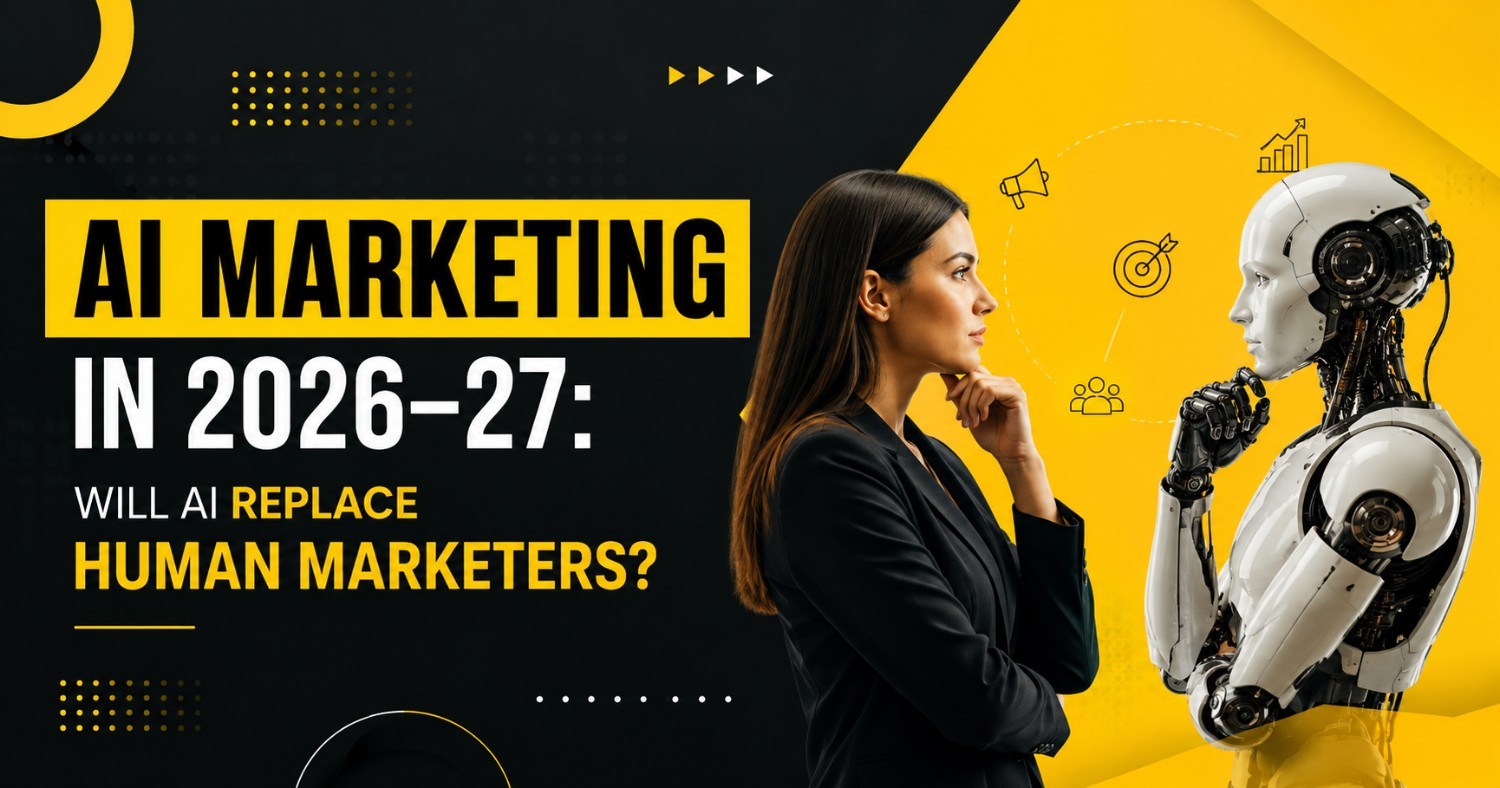
AI Marketing in 2026–27: Will AI Replace Human Marketers?
Explore AI Marketing in 2026–27, its impact on digital marketing, AI tools, automation, and whether AI will replace human marketers or work alongside them.
Introduction
AI Marketing is changing the way businesses attract customers, create content, analyze data, and optimize campaigns. What once required hours of manual research and repetitive marketing work can now be assisted by artificial intelligence, automation, and intelligent software.
From AI in Digital Marketing to AI Marketing Automation, businesses are increasingly using AI to understand customer behavior, personalize campaigns, generate content, improve advertising, and identify new growth opportunities.
But this rapid adoption raises an important question:
Will AI replace human marketers?
The short answer is not completely. AI is becoming extremely powerful at handling repetitive, data-heavy, and automated tasks, but human marketers still play a critical role in strategy, creativity, storytelling, emotional understanding, and decision-making.
The future of marketing is therefore less about AI vs Human Marketers and more about Human-AI Collaboration.
What Is AI Marketing?
AI Marketing refers to the use of artificial intelligence technologies to improve marketing activities, customer experiences, decision-making, and campaign performance.
Instead of relying entirely on manual processes, marketers can use AI to analyze large amounts of information, identify patterns, automate workflows, and create personalized experiences.
Modern AI-Powered Marketing can support areas such as:
Customer segmentation
Audience targeting
Content creation
Search engine optimization
Advertising
Lead generation
Marketing analytics
Campaign optimization
Customer personalization
Marketing automation
For example, an AI system can analyze customer behavior and help a business identify which audience is most likely to convert. A marketer can then use those insights to create a stronger AI Marketing Strategy.
This combination of technology and human judgment is becoming an important part of modern Digital Marketing.
How AI Is Changing Digital Marketing
The impact of AI on marketing is not limited to one channel. It is transforming almost every stage of the customer journey.
1. AI-Powered Personalization
Customers increasingly expect brands to provide relevant experiences instead of generic messages.
AI can analyze browsing behavior, purchase history, engagement patterns, and customer preferences to support personalized marketing.
This can help businesses deliver:
Personalized recommendations
Targeted advertisements
Relevant email campaigns
Customized content
Individual customer experiences
Personalization can make marketing communication more relevant while helping businesses understand their audiences more effectively.
2. AI Content Marketing
Content creation is another area where AI is having a major impact.
Tools powered by generative AI can help marketers brainstorm ideas, create content drafts, summarize information, develop social media concepts, and repurpose existing content.
AI Content Marketing can save time during the initial stages of content production.
However, AI-generated content still requires human review. Marketers need to add brand voice, originality, expert insights, real-world context, and creativity.
The best approach isn't simply asking AI to create everything.
It's using AI to work faster while keeping human creativity in control.
3. AI SEO and AI Search
Search is also evolving rapidly.
Traditional SEO focuses on helping content appear in search engine results, while marketers now also need to consider AI-powered search experiences.
This has created growing interest in:
AI Search
Google AI Overviews
Answer Engine Optimization (AEO)
Generative Engine Optimization (GEO)
AI Content Optimization
AI can assist with keyword research, content analysis, topic discovery, search intent analysis, and optimization.
But successful SEO still requires understanding what people actually want to know.
That is why AI SEO should support human search-intent analysis rather than replace it.
4. AI Advertising and Campaign Optimization
Paid advertising is another major area where AI is becoming increasingly important.
Modern advertising platforms use machine learning and automation to help optimize:
Audience targeting
Bidding
Ad placements
Campaign performance
Conversion optimization
Budget allocation
AI Advertising can process large amounts of campaign data much faster than a human can manually analyze it.
Marketers can then use those insights to make better strategic decisions.
This makes AI particularly valuable for Campaign Optimization and ROI Optimization.
5. AI Lead Generation
Finding and qualifying potential customers is one of the most important marketing activities.
AI Lead Generation can help businesses identify high-intent prospects, score leads, personalize communication, and automate follow-ups.
AI-powered systems can analyze customer interactions and help sales and marketing teams prioritize leads that are more likely to convert.
This can improve efficiency while allowing marketers to spend more time on strategy and customer relationships.
The Rise of AI Marketing Tools
The growing popularity of AI has created an entire ecosystem of tools for marketers.
Some widely used categories include:
Popular platforms such as ChatGPT for Marketing, Claude AI for Marketing, and Gemini for Marketing can assist with research, brainstorming, content development, analysis, and marketing workflows.
But using an AI tool does not automatically create a successful marketing strategy.
The real advantage comes from knowing when, where, and how to use AI effectively.
Will AI Replace Human Marketers?
This is the biggest question surrounding the future of marketing.
AI can already perform many tasks that traditionally required significant human effort. It can analyze data, automate repetitive workflows, generate drafts, identify patterns, and assist with campaign optimization.
But marketing is more than execution.
A successful marketer needs to understand:
Human psychology
Brand positioning
Customer emotions
Business objectives
Market context
Creative storytelling
Strategic decision-making
Communication
These areas require context and judgment.
So, rather than asking “Will AI Replace Marketers?”, businesses should ask:
How can marketers use AI to become more productive, creative, and strategic?
The marketers who learn to work effectively with AI are likely to have a stronger advantage than those who ignore it.
AI vs Human Marketers
The future isn't necessarily AI replacing humans.
It is more likely to be humans using AI to perform better.
AI can process data at incredible speed, automate repetitive tasks, and support decision-making. Human marketers bring creativity, empathy, strategic thinking, and an understanding of real-world customer behavior.
That combination creates a powerful model of Human-AI Collaboration.
AI vs Human Marketers: Who Wins in the AI Era?
The debate around AI vs Human Marketers is becoming more relevant as businesses adopt automation, generative AI, and intelligent marketing platforms. But AI and human marketers have different strengths.
AI is extremely effective at processing information and completing repetitive tasks. Human marketers are better at understanding emotions, culture, brand identity, business context, and unpredictable customer behavior.
Therefore, the strongest model is Human-AI Collaboration, where marketers use AI as a productivity and intelligence layer rather than treating it as a complete replacement.
What Can AI Not Replace in Marketing?
AI can automate many marketing activities, but there are important areas where human expertise remains essential.
Human Creativity
AI can generate ideas, variations, and drafts, but original creative direction still requires human judgment. A strong campaign needs an understanding of culture, audience emotions, brand personality, and context.
Human Creativity in Marketing becomes especially valuable when a brand needs a unique positioning or an emotionally powerful campaign.
Strategic Thinking
AI can analyze data and identify patterns, but business strategy involves decisions that depend on goals, competition, market conditions, resources, and risk.
A marketer must decide not only what the data says, but what the business should do next.
Storytelling and Brand Voice
Customers connect with stories, personalities, and experiences.
AI can assist with writing, but maintaining a consistent brand identity requires human oversight. Strong storytelling combines creativity, empathy, cultural understanding, and business objectives.
Emotional Intelligence
Marketing is ultimately about people.
Understanding why customers hesitate, what motivates them, and how they emotionally respond to a brand requires more than analyzing data. Human empathy remains an important part of effective marketing.
AI Agents and the Future of Marketing
The next evolution of AI Marketing Automation is moving beyond simple tools toward intelligent systems that can perform multi-step tasks.
AI Agents for Marketing can potentially assist with activities such as:
Researching audiences
Monitoring campaigns
Analyzing performance
Creating workflow suggestions
Triggering follow-up actions
Updating marketing processes
Supporting customer journeys
This emerging approach is often associated with Agentic AI Marketing, where AI systems can operate across connected workflows rather than simply responding to individual prompts.
For marketers, this means repetitive execution could become increasingly automated.
Instead of manually performing every task, marketers may increasingly supervise AI-powered workflows and focus on strategy, creative direction, and business decisions.
What Skills Will Marketers Need in the Future?
As AI becomes more capable, marketers need to develop skills that complement technology rather than compete directly with it.
Important AI Marketing Skills include:
1. AI Literacy
Marketers should understand how AI tools work, what they are good at, and where they can produce unreliable results.
2. Strategic Thinking
Businesses still need people who can connect marketing activities with broader business objectives.
3. Creative Thinking
Creative concepts, campaign direction, storytelling, and brand positioning will remain valuable.
4. Data Analysis
Marketers should understand how to interpret Marketing Analytics, campaign data, customer behavior, and performance metrics.
5. Customer Psychology
Understanding customer motivations and behavior helps marketers create more relevant experiences.
6. AI Workflow Management
Future marketers will increasingly need to know how to combine AI tools, automation, data, and human review into efficient workflows.
The most valuable marketer may not be the person who knows the most AI tools. It may be the person who knows how to combine AI capabilities with strong marketing judgment.
AI Marketing in India
The adoption of AI is creating new opportunities for Indian businesses across industries.
From startups and eCommerce companies to service providers and established brands, businesses can use AI Marketing in India to improve customer acquisition, personalization, content production, advertising, and automation.
AI Digital Marketing in India can support businesses with:
Automated customer communication
AI-powered content workflows
Lead qualification
Campaign analysis
Personalized marketing
Customer support
Marketing automation
For AI Marketing for Indian Businesses, the biggest opportunity is not simply replacing existing marketing teams. It is improving productivity while allowing teams to serve larger audiences with better personalization.
AI Marketing in Surat
Local businesses are also entering the AI-driven marketing era.
Businesses looking for AI Marketing in Surat can use AI-supported strategies to improve content production, customer communication, lead generation, advertising analysis, and marketing automation.
An AI Digital Marketing in Surat strategy can combine:
SEO
Local SEO
Google Ads
Meta Ads
Content Marketing
AI-powered automation
Lead Generation
Customer personalization
For businesses that want to adopt AI without losing the human side of marketing, working with an AI Marketing Agency in Surat can help create structured workflows that combine technology with strategic expertise.
Businesses can also explore AI Marketing Services in Surat to identify which marketing activities should be automated and which should remain human-led.
The Future of Digital Marketing: AI + Humans
The future of marketing is unlikely to be a simple competition between humans and machines.
Instead, Future of Digital Marketing will be shaped by collaboration.
AI will increasingly handle:
Data processing
Repetitive tasks
Automated workflows
Predictive analysis
Personalization
Campaign optimization
Large-scale content assistance
Humans will continue to lead:
Strategy
Creativity
Brand positioning
Emotional communication
Business decisions
Customer relationships
Original campaign concepts
This creates a new model where marketers become more strategic and technology-driven.
The future marketer will not necessarily compete with AI.
The future marketer will know how to work with AI.
Ready to Build an AI-Powered Marketing Strategy?
At Grow Shadow – IT & Marketing Solution Company, we help businesses combine modern AI Marketing, digital strategy, SEO, performance marketing, content, automation, and lead generation to build scalable online growth systems.
Our approach focuses on using AI where it creates genuine efficiency while keeping human strategy and creativity at the center.
Businesses can explore solutions around:
AI Marketing Strategy
AI Marketing Automation
AI SEO
AI Lead Generation
AI-Powered Marketing
Performance Marketing
SEO
Content Marketing
Social Media Marketing
👉 Want to understand how AI can improve your marketing without replacing the human strategy behind your brand? Contact Grow Shadow and build a smarter, AI-powered marketing workflow for your business.
Conclusion
So, will AI replace human marketers?
Probably not in the way many people imagine.
AI will continue automating repetitive marketing tasks, improving analytics, accelerating content workflows, and supporting campaign optimization. At the same time, human marketers will remain essential for creativity, strategic thinking, emotional intelligence, storytelling, brand building, and business decision-making.
The real shift is from human vs AI to human + AI.
Businesses that learn to combine intelligent automation with human expertise can create faster, more personalized, and more scalable marketing systems.
The marketers who adapt, learn new AI Marketing Skills, understand AI tools, and continue developing their human strengths will be better positioned for the future of marketing.
The goal isn't to compete with AI.
The goal is to become the marketer who knows how to use it better.
We'd Love to Hear You!
Chat with US
 Send Us Mailinfo@growshadow.com
Call Us
 Call 24/7 Hours+91 70693 32037
Visit Office