



 Product Packaging Design
₹20,000 Digital Marketing Budget in 2026: How to Get More Leads
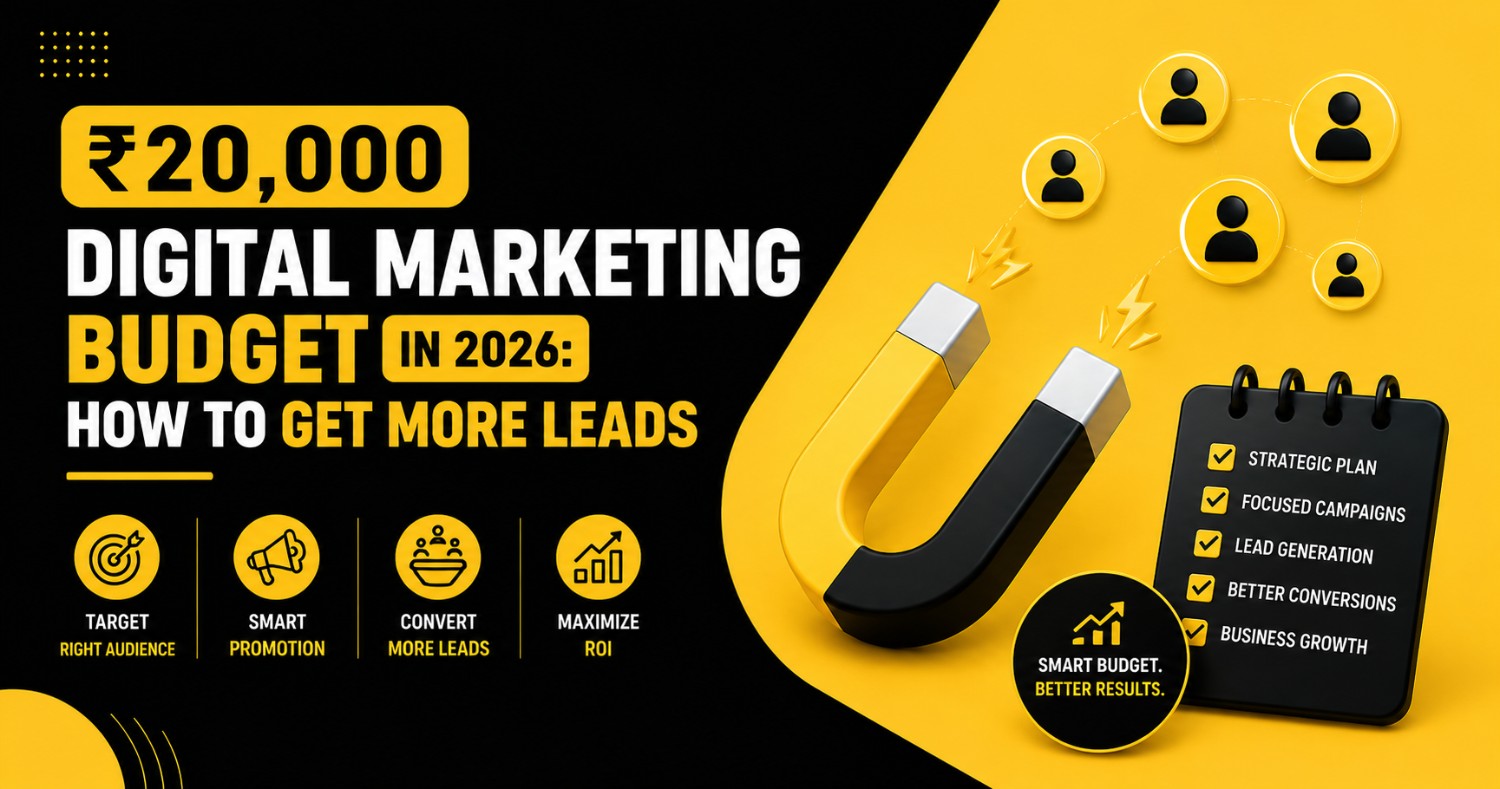
Learn how to plan a ₹20,000 digital marketing budget in 2026 using Google Ads, Meta Ads, SEO and lead generation strategies to grow your business.
If you have ₹20,000 per month to spend on digital marketing, the biggest question is not simply where to spend it. The real question is: how can you turn that limited budget into qualified leads and measurable business growth?
Many small businesses make the same mistake — they divide a small budget across Google Ads, Meta Ads, SEO, social media, content and other channels without giving any single channel enough focus. Research-based guidance for Indian small businesses similarly emphasizes that low budgets need focused allocation rather than excessive channel fragmentation.
In 2026, digital marketing budget planning should be based on your business type, target audience, location, customer acquisition cost, offer and expected conversion — not simply on an arbitrary percentage split.
For a local service business, for example, Google Search can capture people already looking for a service, while Meta Ads can help with awareness, offers and retargeting. E-commerce businesses may need a different mix because product discovery and visual advertising play a larger role.
So, if ₹20,000 is your monthly marketing budget, how should you actually use it?
Is ₹20,000 Enough for Digital Marketing in 2026?
Yes — ₹20,000 can be a useful starting budget, especially for a small business that is testing digital lead generation. But it should not be treated as a guaranteed formula for a fixed number of leads.
Your results can vary significantly depending on:
Industry and competition
City and target location
Product or service pricing
Search demand
Offer quality
Ad creative
Landing page experience
Audience targeting
Follow-up process
Conversion rate
A ₹20,000 budget for a high-ticket local service can work very differently from ₹20,000 spent promoting a low-ticket product.
This is why the goal should not simply be “spend ₹20,000.” The goal should be to create a system where every part of the budget has a specific purpose.
Digital Marketing Budget Planning: Where Should ₹20,000 Go?
Before choosing a channel, divide your budget according to the role it needs to play.
For a lead-generation-focused business, a practical starting framework could look like this:
This is not a universal formula. Your allocation should change according to your business and campaign objective.
For example, current guidance for Indian SMBs places greater emphasis on Google Search for service businesses because it captures existing search intent, while Meta becomes more important for e-commerce, D2C and awareness-led campaigns.
The key principle is simple:
Don't try to be everywhere with ₹20,000. Be effective where your customers are most likely to convert.
Google Ads vs Meta Ads: Where Should You Spend?
This is one of the biggest decisions when creating a ₹20,000 digital marketing plan for a small business.
Google Ads
Google Search Ads can be useful when potential customers are already searching for a product or service.
For example:
“digital marketing agency in Surat”
“best salon near me”
“car service in Surat”
“home interior designer Surat”
These searches indicate an existing requirement. Your advertisement appears when the customer is actively looking for a solution.
That makes Google Search particularly relevant for lead generation, local services and high-intent searches.
Meta Ads
Meta Ads, including Facebook and Instagram, help businesses reach targeted audiences through paid social media campaigns.
Instead of waiting for someone to search, you can put your offer in front of a defined audience based on factors such as interests, demographics, location and previous interactions.
This can be useful for:
Fashion
Jewellery
Restaurants
E-commerce
Education
Events
Beauty
Consumer products
Local offers
Meta can also be valuable for retargeting people who have already interacted with your brand.
So the choice isn't simply Google Ads vs Meta Ads.
The better question is:
“Is your audience ready to buy, still comparing options, or just discovering your brand?”
If they're actively searching, Search can be powerful. If you need to create demand, showcase products or retarget interested audiences, Meta can play a bigger role.
How to Get More Leads With a ₹20,000 Marketing Budget
Getting more leads isn't only about increasing ad spend.
Your complete journey should look something like:
Ad → Landing Page → Lead Form/WhatsApp → Follow-Up → Sales Conversation → Customer
If one part of this funnel is weak, increasing the advertising budget may simply increase wasted spend.
For example, an advertisement might generate plenty of clicks, but if the landing page is slow, confusing or has no clear CTA, those clicks may not turn into leads.
That's why conversion optimization needs to be part of your marketing budget.
A dedicated landing page can focus on:
One clear offer
One primary CTA
Strong headline
Relevant benefits
Trust signals
Customer reviews
Simple lead form
Mobile-friendly design
WhatsApp/contact option
The objective is not to get more traffic just for the sake of traffic.
The objective is to turn relevant traffic into measurable enquiries.
Don't Ignore Lead Follow-Up
One more area that businesses often overlook is what happens after the lead arrives.
Suppose your campaign generates 30 enquiries, but your team responds several hours later. Some prospects may already have contacted a competitor.
Your lead generation strategy therefore needs a follow-up system.
You can use:
WhatsApp
Phone calls
Email
CRM reminders
Automated responses
Lead qualification
Retargeting
A fast and relevant follow-up can make the difference between a lead that disappears and a lead that becomes a customer.
How to Plan Your ₹20,000 Marketing Budget Based on Your Business
There is no single digital marketing budget allocation that works for every business. The right strategy depends on what you sell, how customers find you and how quickly you need leads.
For example, a local salon, a real estate company, an e-commerce brand and a B2B service provider should not use the same ₹20,000 marketing plan.
Local Service Business
For businesses such as salons, clinics, restaurants, gyms or home services, local search intent can be extremely valuable.
A possible strategy is to prioritize:
Google Search Ads
Google Business Profile
Local SEO
Meta Ads for local offers
WhatsApp lead follow-up
The goal is to reach people who are already looking for a nearby product or service and make it easy for them to call, message or submit an enquiry.
E-commerce Business
For an e-commerce or D2C brand, visual discovery can be more important.
A budget can focus on:
Meta Ads
Instagram advertising
Google Shopping/Search
Retargeting
Product creatives
Here, Meta Ads for small business can be useful for product discovery, while Google can capture users who are already searching for specific products.
B2B or High-Ticket Service Business
For agencies, consultants, IT companies and other B2B businesses, lead quality matters more than simply generating a large number of enquiries.
A focused strategy can include:
Google Search Ads
Dedicated landing page
Lead qualification
Retargeting
Email or WhatsApp follow-up
For these businesses, customer acquisition cost (CAC) should be evaluated against the actual value of a new customer.
How to Measure a ₹20,000 Digital Marketing Budget
Spending ₹20,000 is only the beginning. You also need to know what that ₹20,000 produced.
Cost Per Lead (CPL)
CPL tells you how much you are paying to generate one lead.
Example:
If you spend ₹10,000 and receive 20 leads, your average CPL is ₹500.
But don't automatically assume that ₹500 CPL is good.
If those 20 leads are poor quality, the campaign may still be losing money.
Customer Acquisition Cost (CAC)
CAC looks at how much it actually costs to acquire a paying customer.
For example:
₹10,000 marketing spend → 20 leads → 4 customers
Your acquisition cost is based on the customers generated, not simply the number of leads.
Conversion Rate
If 100 people visit your landing page and 5 submit an enquiry, the conversion rate is 5%.
Improving your conversion rate can sometimes produce more leads without increasing your advertising budget.
ROI and ROAS
ROI helps you understand the return on the overall investment.
ROAS focuses specifically on advertising revenue compared with advertising spend.
The exact target will depend on your margins, product value and business model.
Common ₹20,000 Marketing Budget Mistakes
A small budget can disappear quickly if you don't have a clear strategy.
1. Spending on Too Many Channels
Putting ₹3,000–₹4,000 into five different platforms may look diversified, but it can leave every campaign underfunded.
The reference research also emphasizes concentration at lower budgets rather than spreading a small amount across too many channels.
2. Sending Paid Traffic to the Homepage
Your advertisement may be great, but if visitors land on a confusing homepage with no clear CTA, your lead generation strategy can struggle.
A dedicated landing page should match the advertisement and make the next action obvious.
3. Focusing Only on Cheap Leads
A campaign generating cheap leads isn't automatically successful.
Always compare:
CPL → Lead Quality → Conversion Rate → CAC → Revenue
4. Not Tracking Conversions
If you don't know which campaign generated the lead, you're essentially guessing where your marketing budget is working.
Use proper conversion tracking, analytics and campaign-level attribution.
5. Changing Campaigns Too Quickly
Testing is important, but constantly changing targeting, creatives and budgets makes it difficult to understand what actually worked.
Give your campaigns enough time and data to make informed decisions.
Can AI Help You Get More From ₹20,000?
Absolutely.
In 2026, AI marketing can help small businesses reduce the time and effort required for repetitive marketing tasks.
You can use AI for:
Ad copy variations
Content ideas
Creative concepts
Audience research
Lead qualification
Customer segmentation
Follow-up messages
Campaign analysis
Reporting
Marketing automation
For example, instead of creating one advertisement and hoping it works, you can develop multiple creative angles, test them and identify which message generates better engagement or leads.
But AI should support your strategy — not replace it.
Your AI marketing strategy still needs human decisions around positioning, customer psychology, offers, pricing and brand communication.
₹20,000 Digital Marketing Strategy for Surat Businesses
For a business operating in Surat, a generic national marketing strategy may not always be necessary.
A local digital marketing approach can focus specifically on people within the service area.
For example, a Surat business could combine:
Google Search + Google Business Profile + Local SEO + Meta Ads + WhatsApp
with location-specific creatives and messaging.
A restaurant could target customers within nearby areas.
A salon could promote a limited-time local offer.
A real estate business could target people searching for properties in specific Surat locations.
A textile business could use digital campaigns to reach B2B buyers.
For businesses looking for professional support with digital marketing for small businesses in Surat, a local agency such as Grow Shadow can combine SEO, social media marketing, performance marketing, creative content and lead-generation campaigns according to the business objective.
The important thing is not simply being based in Surat. The campaign needs to understand the local audience, buying intent and competition.
A Simple 90-Day ₹20,000 Marketing Plan
Instead of changing your entire strategy every week, use a structured 90-day approach.
Month 1 — Test
Focus on:
Audience research
Offer testing
Keyword selection
Ad creative testing
Landing page
Conversion tracking
The objective is to identify which combinations are generating relevant enquiries.
Month 2 — Optimize
Now analyze:
Best-performing keywords
Best ad creatives
Cost per lead
Lead quality
Conversion rate
Customer acquisition cost
Reduce waste and move more budget toward what is performing.
Month 3 — Scale
Once you identify consistent winners, gradually increase investment in them.
At this stage, you can also test a new channel or creative without putting the entire ₹20,000 budget at risk.
This follows the broader principle from the reference research: establish tracking, review performance systematically and reallocate budget toward channels that demonstrate stronger results.
Conclusion
A ₹20,000 digital marketing budget in 2026 can be a strong starting point for a small business — but only when every rupee has a clear purpose.
Don't ask only:
“Where can I spend ₹20,000?”
Ask:
“Which channel can bring my business the most valuable customers, and how can I improve the conversion of every lead I generate?”
Start with the channel that matches your customer journey. Build a strong landing page or conversion point. Track CPL, CAC, conversion rate, ROI and ROAS. Follow up quickly. Then optimize based on actual data.
For Surat businesses, adding local SEO, Google Business Profile, location-based advertising, Gujarati creatives and WhatsApp follow-up can make a focused budget even more relevant to the local market.
And as AI becomes a bigger part of digital marketing in 2026, businesses can use it to create, test, analyze and automate faster — while keeping human strategy at the center.
The goal isn't to spend more. It's to make your ₹20,000 work smarter.
FAQs
Is ₹20,000 enough for digital marketing in 2026?
₹20,000 can be a practical starting budget for a small business, particularly when it is focused on one or two suitable channels. Results depend on industry, competition, location, offer, targeting and conversion rate.
How should I spend ₹20,000 on digital marketing?
Start by identifying your primary objective. A lead-generation business may prioritize Google Search Ads and landing-page optimization, while an e-commerce brand may allocate more toward Meta and Google Shopping.
How can Surat businesses generate leads with a small marketing budget?
Surat businesses can combine Google Search, Google Business Profile, local SEO, Meta Ads, WhatsApp follow-up and location-specific content to reach relevant customers within their target areas.
Can AI reduce digital marketing costs?
AI can reduce the time required for content creation, creative testing, analysis and repetitive tasks. However, it should complement — not replace — your marketing strategy, customer research and human decision-making.
We'd Love to Hear You!
Chat with US
 Send Us Mailinfo@growshadow.com
Call Us
 Call 24/7 Hours+91 70693 32037
Visit Office