


 Product Packaging Design
How AI Is Transforming IT Services in 2026
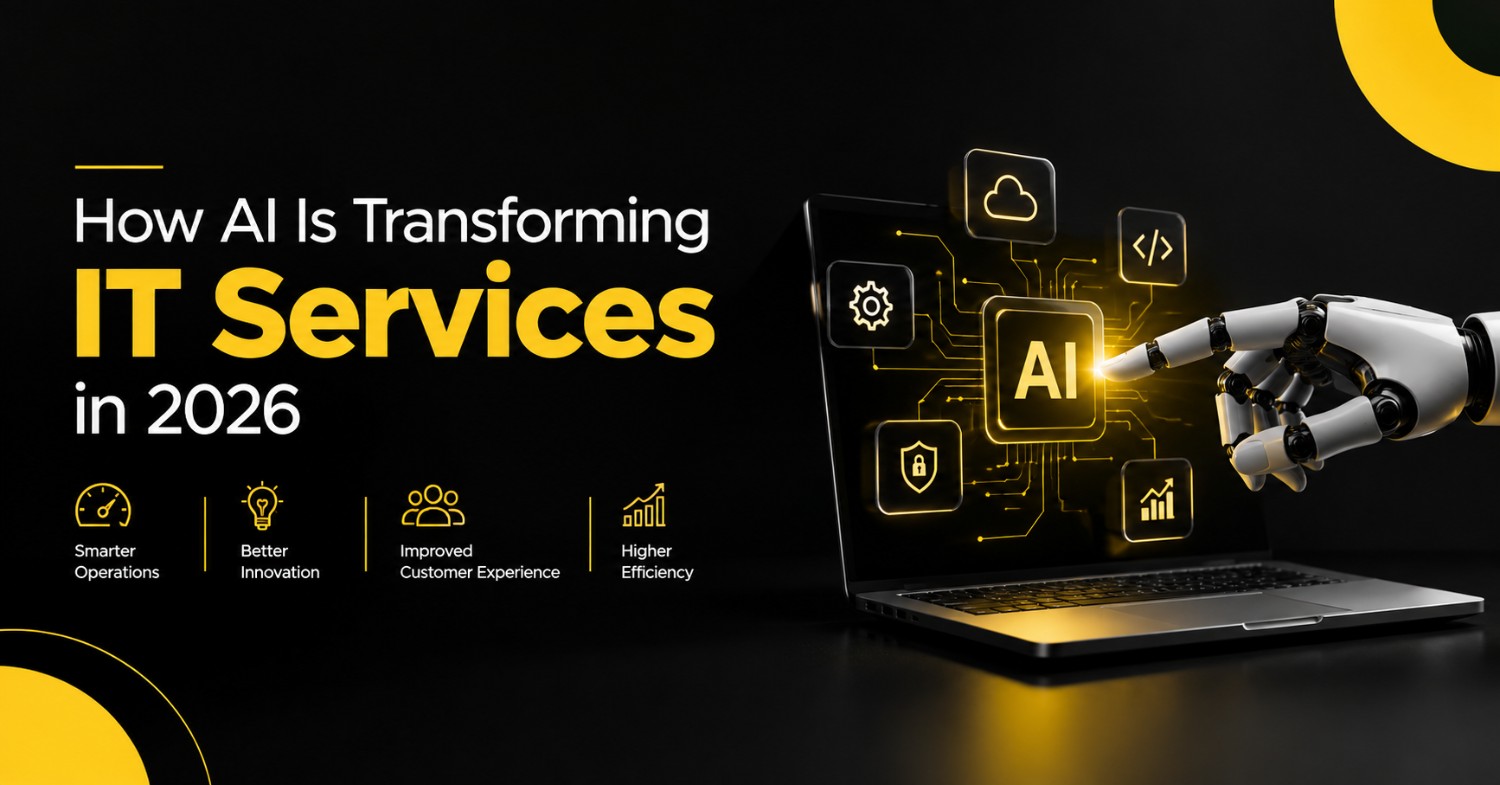
Discover how AI is transforming IT services in 2026 through automation, AIOps, AI-powered IT support, cybersecurity, cloud infrastructure, software development, and managed IT services.
Introduction
Artificial intelligence is changing the way businesses manage technology, support users, monitor infrastructure, and deliver digital services. What was once mainly used for experimentation and automation is now becoming part of everyday IT services, from helpdesk support and cybersecurity to cloud management and software development.
The shift is not simply about replacing manual tasks. AI in IT Services is helping businesses detect issues earlier, automate repetitive workflows, analyze large amounts of data, and provide faster support.
For IT service providers, this creates a broader opportunity. AI-powered IT services can combine automation with human expertise to make IT operations more proactive, scalable, and responsive.
In 2026, businesses are therefore looking beyond traditional IT support. They are increasingly evaluating how AI Services, automation, AIOps, cybersecurity, cloud technologies, and managed services can contribute to better operational outcomes.
What Is AI in IT Services?
AI in IT Services refers to the use of artificial intelligence technologies to improve, automate, or support IT-related processes and services.
Instead of relying entirely on people to monitor systems, respond to tickets, identify unusual activity, or perform repetitive tasks, AI can assist with these activities by analyzing data and identifying patterns.
For example, an AI-enabled IT system can help:
Classify and prioritize support tickets
Identify unusual system behaviour
Assist users with common technical issues
Monitor IT infrastructure
Detect potential security threats
Automate repetitive workflows
Assist software development and testing
Analyze operational data
This does not mean that AI makes human IT professionals unnecessary. In many situations, the more practical approach is human expertise + AI assistance.
AI can handle repetitive or data-heavy activities while IT professionals focus on complex problems, decision-making, security, architecture, and customer requirements.
That combination is becoming an important part of modern IT services and solutions.
Why Are Businesses Adopting AI-Powered IT Services?
Businesses are adopting AI-powered IT services because traditional IT environments can involve large amounts of repetitive work, continuous monitoring, and increasingly complex technology stacks.
AI can help address some of these challenges while allowing IT teams to focus their time and expertise where they matter most.
Faster IT Support
AI-powered helpdesk systems can assist with common questions, categorize tickets, retrieve relevant information, and route issues to the appropriate team.
This can help reduce unnecessary manual work and improve the speed of initial support.
Better IT Monitoring
Modern businesses may have applications, cloud infrastructure, networks, databases, and security systems running simultaneously.
AI can analyze large volumes of operational data and help identify unusual patterns that may require attention.
Reduced Repetitive Work
Routine activities such as ticket categorization, reporting, workflow triggers, and certain support processes can be assisted or automated.
This allows IT teams to spend more time on higher-value technical work.
Improved Scalability
As businesses grow, their IT requirements also become more complex. AI can help IT teams handle larger volumes of data, support requests, and monitoring requirements without increasing manual effort at the same rate.
More Proactive IT Management
Traditional IT support often reacts after an issue occurs. AI can help move some processes toward predictive and proactive IT management by identifying patterns and potential problems earlier.
7 Ways AI Is Transforming IT Services
1. AI-Powered IT Support and Helpdesk
One of the most visible applications of AI is in IT support and helpdesk operations.
Traditional helpdesks often receive a large number of repetitive requests. Password issues, software questions, access requests, basic troubleshooting, and similar problems can consume significant amounts of an IT team's time.
AI can assist by understanding support requests, categorizing tickets, suggesting solutions, retrieving information from knowledge bases, and responding to common questions.
For example, an AI-assisted helpdesk solution can recognize that a user is experiencing a common software issue and provide relevant troubleshooting steps before escalating the problem to a human technician.
The human team can then focus on more complex issues that require technical investigation or decision-making.
The goal is not simply to automate support. It is to make support faster, more consistent, and easier to scale.
2. AI for IT Operations and AIOps
IT environments generate enormous amounts of operational data from servers, applications, networks, cloud platforms, and other infrastructure.
This is where AI for IT Operations and AIOps can become valuable.
AIOps uses AI and machine learning techniques to help IT teams analyze operational data, identify patterns, detect anomalies, and support incident management.
For example, instead of waiting for users to report a performance problem, an AI-assisted monitoring system may identify an unusual change in system behaviour and alert the IT team.
Common applications include:
Anomaly detection
Infrastructure monitoring
Predictive alerts
Incident detection
Performance analysis
Event correlation
This can help organizations move from a purely reactive IT model toward a more proactive approach to IT operations.
3. AI Automation in IT Services
Automation is another major area where AI is changing IT service delivery.
Traditional automation follows predefined rules. AI-assisted automation can add the ability to analyze information, identify patterns, and support decisions within workflows.
Businesses can use AI Automation in IT Services for activities such as:
Ticket routing
Automated reporting
Routine service requests
Workflow triggers
Data analysis
Repetitive maintenance processes
IT documentation
For example, when a support ticket arrives, an AI system can analyze its content, determine its category, assign a priority, and route it to the appropriate team.
This can reduce manual steps while allowing employees to review and handle exceptions.
The best results generally come when businesses automate well-defined, repetitive processes first, rather than trying to automate every IT activity at once.
4. AI in Cybersecurity Services
Cybersecurity is another important area where AI is influencing modern IT services.
Businesses generate large amounts of security-related data, making continuous monitoring difficult to manage manually. AI can assist security teams by analyzing activity, identifying unusual patterns, and helping prioritize potential threats.
Potential applications include:
Threat detection
Suspicious activity analysis
Security monitoring
Anomaly detection
Incident analysis
Faster response workflows
However, cybersecurity is also an area where human oversight remains important. AI-generated alerts and recommendations need to be evaluated within the organization's security policies, infrastructure, and risk context.
For businesses, the goal should be to use AI as a security-support capability, rather than assuming that automation alone can eliminate cybersecurity risks.
5. AI and Cloud & IT Infrastructure
Cloud environments and IT infrastructure have become increasingly complex as businesses use more applications, data, servers, and digital services. AI in IT Services can help IT teams monitor these environments and make better use of operational data.
AI can assist with:
Cloud resource monitoring
Infrastructure performance analysis
Capacity planning
Anomaly detection
Resource optimization
Predictive maintenance
Automated infrastructure workflows
For example, an AI-assisted system can identify unusual resource consumption and alert an IT team before it becomes a larger operational issue.
This makes IT Infrastructure management more proactive and can help teams identify potential problems earlier.
However, AI-based infrastructure management still requires appropriate configuration, monitoring, security controls, and human oversight.
6. AI in Software Development and IT Modernization
AI is also changing how software is developed, tested, maintained, and modernized.
Developers can use AI-assisted tools to support activities such as:
Code generation
Code explanation
Debugging assistance
Test generation
Documentation
Code analysis
Application modernization
For businesses using AI Solutions, this can potentially shorten parts of the development workflow and help technical teams work more efficiently.
AI can also assist with legacy application modernization by helping teams understand existing code, identify dependencies, and support the transition toward newer architectures.
But AI-generated code still requires human review. Security, performance, maintainability, and business requirements cannot simply be delegated to an AI system without appropriate technical oversight.
7. AI Managed IT Services
Traditional managed IT services often focus on monitoring systems, maintaining infrastructure, responding to incidents, and providing technical support.
With AI, these services can become more proactive.
AI Managed IT Services can combine AI-assisted monitoring, automation, analytics, and human expertise to support areas such as:
Proactive infrastructure monitoring
Predictive maintenance
Automated ticket handling
Performance analysis
Security monitoring
IT reporting
Incident prioritization
For example, instead of waiting for a system failure and then responding to it, AI-assisted monitoring can help identify unusual behaviour and bring the issue to the IT team's attention earlier.
The result is not necessarily a fully autonomous IT environment. A more practical model is AI-assisted managed IT services, where automation handles repetitive processes while experienced IT professionals remain responsible for complex decisions.
AI Use Cases in IT Services
The impact of AI becomes easier to understand when we look at specific IT service applications.
These examples show why AI Use Cases in IT Services extend far beyond chatbots. AI can influence the way IT teams monitor, support, develop, secure, and manage technology environments.
How AI Is Changing IT Service Management
AI in IT Service Management is particularly important because ITSM involves many structured processes that generate large amounts of information.
AI can assist with:
Incident management
Service request classification
Ticket prioritization
Knowledge management
Automated workflows
User support
Problem identification
Service reporting
For example, when a user submits a support request, an AI system can analyze the request, identify its category, suggest relevant knowledge-base information, and route it to the appropriate team.
This can reduce repetitive manual steps while allowing IT professionals to focus on incidents that require deeper investigation.
The important distinction is that AI can augment IT service management, rather than making human expertise irrelevant.
Benefits of AI in IT Services for Businesses
The value of AI should ultimately be measured by the business and operational outcomes it creates.
Some potential Benefits of AI in IT Services include:
Faster Response
AI can assist with ticket classification, common support requests, monitoring, and incident identification.
Reduced Repetitive Work
Routine processes can be automated or AI-assisted, allowing IT teams to spend more time on complex tasks.
Better Monitoring
AI can analyze operational data continuously and help identify unusual behaviour.
Improved Scalability
AI-assisted workflows can help IT teams handle growing volumes of requests and data.
Proactive Problem Detection
Predictive analysis and anomaly detection can help teams identify potential issues earlier.
Better Resource Utilization
By reducing repetitive manual activities, businesses can make better use of their technical resources.
However, businesses should evaluate these benefits against actual results rather than assuming that implementing an AI tool automatically creates value.
AI IT Services in India
India's IT services industry is experiencing a broader shift toward AI-assisted delivery, automation, cloud services, cybersecurity, software development, and managed services.
For businesses evaluating AI IT Services in India, the opportunity is not limited to implementing a chatbot or automating a single task.
AI can be considered across the wider technology lifecycle, including:
Software development
IT operations
Cybersecurity
Cloud infrastructure
IT support
Managed services
Data analysis
Business process automation
Indian businesses also need to consider areas such as data security, AI governance, employee training, integration, and human oversight when adopting AI.
The most practical approach is to identify a specific business or IT problem first and then determine whether an AI solution can address it effectively.
AI IT Services in Surat: Opportunities for Local Businesses
The same transformation is relevant to businesses looking for AI IT Services in Surat.
Surat has businesses across textile, jewellery, manufacturing, retail, real estate, education, professional services, and technology. Each sector can apply AI differently depending on its operational requirements.
Textile & Fashion Businesses
AI can assist with customer support, order workflows, data analysis, and repetitive operational processes.
Jewellery Businesses
AI solutions can support customer enquiries, product information, lead follow-ups, and internal workflows.
Manufacturing Businesses
AI can assist with monitoring, predictive maintenance, operational analysis, and infrastructure management.
Education Businesses
AI services can support student enquiries, helpdesk workflows, communication, and administrative processes.
Real Estate Businesses
AI can help with lead qualification, customer communication, data organization, and follow-up workflows.
For local businesses, AI Services in Surat should not simply mean adopting the latest technology. The better approach is to identify where automation, analytics, support, or monitoring can create a measurable improvement.
Businesses can also work with relevant IT Companies in Surat or a Software Company in Surat when AI requires integration with existing software, websites, cloud infrastructure, or internal systems.
How to Choose the Right AI IT Service for Your Business
Not every business needs the same AI solution.
Before investing in AI Consulting Services or implementing an AI-powered system, consider these factors:
1. Identify the Actual Problem
Start with a specific operational challenge rather than starting with a technology.
2. Determine Whether AI Is Appropriate
Some problems can be solved with traditional automation or better processes. AI should be used when it adds meaningful value.
3. Check Integration Requirements
Consider how the solution will connect with existing software, databases, cloud platforms, and workflows.
4. Consider Security and Privacy
Understand what data the AI system will access and how that data will be processed and protected.
5. Evaluate Scalability
Choose a solution that can support future business and technology requirements.
6. Define Measurable Outcomes
Decide how success will be measured before implementation.
A good AI Solutions strategy should be based on business requirements rather than simply choosing the most advanced AI technology available.
Challenges of Using AI in IT Services
AI can create significant opportunities, but implementation also comes with challenges.
Data Quality
AI systems depend on the quality and relevance of the information they use.
Security and Privacy
Businesses need appropriate controls when AI systems interact with sensitive business or customer data.
Integration Complexity
Connecting AI with existing IT infrastructure and software can require technical planning.
Employee Training
IT teams may need new skills to manage, monitor, evaluate, and govern AI-enabled systems.
Over-Automation
Not every IT process should be fully automated. Critical decisions may still require human review.
Cost Management
Businesses should consider implementation, integration, maintenance, and ongoing operational costs—not just the initial software price.
The Future of AI in IT Services
The Future of AI in IT Services is likely to involve deeper integration between AI, automation, cloud infrastructure, cybersecurity, software development, and managed services.
One important development is Agentic AI, where AI systems can perform multi-step tasks with greater autonomy under defined controls.
Future IT environments may increasingly use AI to:
Detect and investigate incidents
Recommend or initiate predefined actions
Optimize infrastructure
Assist cybersecurity teams
Support software development
Automate service workflows
Provide more proactive IT management
At the same time, human oversight, governance, security, and technical expertise will remain important.
The future is therefore less about AI versus IT professionals and more about how IT professionals can work effectively with increasingly capable AI systems.
AI in IT Services 2026: What Businesses Should Do Next
Businesses don't need to transform their entire IT environment overnight.
A practical approach is:
1. Identify
Find repetitive, time-consuming, or difficult-to-monitor IT processes.
2. Prioritize
Select one use case where AI could create measurable value.
3. Implement
Choose an appropriate AI solution and integrate it carefully.
4. Test
Monitor performance, accuracy, security, and user feedback.
5. Measure
Track operational and business outcomes.
6. Scale
Expand successful use cases to other IT processes.
Identify → Prioritize → Implement → Test → Measure → Scale
This approach helps businesses treat AI in IT Services 2026 as a practical transformation strategy rather than simply following an AI trend.
Grow Your Business With AI-Powered IT Services
AI can help businesses improve IT support, automate repetitive processes, strengthen monitoring, and build more scalable technology operations. But the right solution depends on the organization's infrastructure, goals, budget, and technical requirements.
At Grow Shadow, businesses can explore practical technology and digital strategies designed around their specific requirements. Whether the goal is AI Solutions, automation, software development, SEO, or broader digital transformation, the focus should remain on using technology to create measurable business value.
FAQs
What is AI in IT services?
AI in IT Services means using artificial intelligence to support or automate IT-related activities such as helpdesk support, infrastructure monitoring, cybersecurity, software development, incident management, and IT operations.
How is AI transforming IT services in 2026?
AI is transforming IT services through automation, AIOps, AI-assisted IT support, cybersecurity analysis, cloud optimization, software development assistance, and more proactive managed IT services.
What are the benefits of AI in IT services?
Key benefits can include faster support, reduced repetitive work, improved monitoring, proactive issue detection, greater scalability, and more efficient use of IT resources.
What are the most common AI use cases in IT services?
Common use cases include AI-powered helpdesks, ticket classification, AIOps, anomaly detection, cybersecurity monitoring, cloud optimization, software development assistance, predictive maintenance, and automated IT workflows.
How can businesses use AI IT services in Surat?
Businesses can use AI IT Services in Surat for IT support, workflow automation, infrastructure monitoring, cybersecurity, software development, data analysis, and managed IT operations. The right use case depends on the business's specific technology and operational requirements.
Conclusion
AI is transforming IT services from primarily reactive support toward more automated, proactive, predictive, and data-driven service delivery.
From helpdesks and AIOps to cybersecurity, cloud infrastructure, software development, and managed services, AI is becoming part of the broader IT technology ecosystem.
But successful adoption is not about using AI everywhere.
It's about identifying the right problem, choosing the right solution, maintaining appropriate human oversight, and measuring the outcome.
The goal isn't simply to add AI to IT services. The goal is to use AI where it creates meaningful value for the business and its customers.
We'd Love to Hear You!
Chat with US
 Send Us Mailinfo@growshadow.com
Call Us
 Call 24/7 Hours+91 70693 32037
Visit Office