

 Product Packaging Design
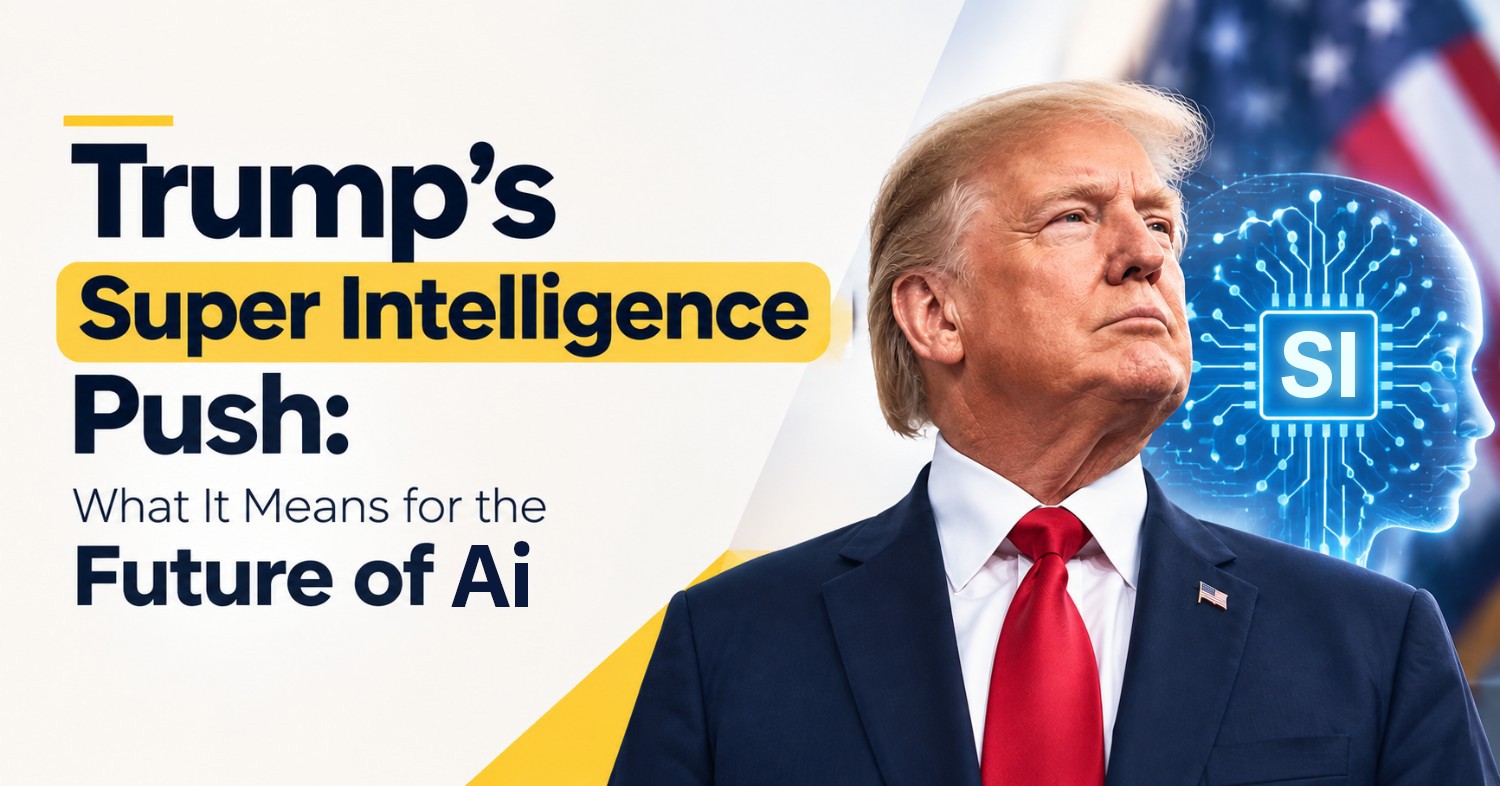
Trump’s Super Intelligence Push: What It Means for the Future of AI
Explore Trump’s Super Intelligence push, understand Super Intelligence vs AI, and discover what AI to Super Intelligence could mean for the Future of AI, Super Intelligence Technology, AI Business Technology, and Super Intelligence for Businesses in India and Surat.
Trump’s Super Intelligence Push: What Happened?
Artificial intelligence has been one of the biggest technology shifts of the past decade, but a new terminology debate is putting the future of AI back in the spotlight. On September 29, 2026, U.S. President Donald Trump signed an executive order titled “Inaugurating the Era of Super Intelligence.” The order says that the capabilities of today’s frontier systems increasingly represent a new era of Super Intelligence, and directs the U.S. executive branch to use the terms “Super Intelligence” and “SI” in place of “Artificial Intelligence” and “AI” in specified official communications.
What Actually Changed?
The change is specifically focused on the U.S. executive branch. Under the order, executive departments and agencies are directed, to the maximum extent permitted by law, to use “Super Intelligence” and “SI” in official correspondence, public communications, websites, reports, policy documents and other non-statutory documents.
However, this does not mean that AI technology has suddenly been renamed worldwide.
The order states that, for purposes of the order, “Super Intelligence” and “SI” mean the technologies and systems encompassed by the existing federal statutory definition of “artificial intelligence.” It also says that previously issued regulations, Presidential actions, contracts, grants and other historical documents do not need to be altered because of the terminology change.
Another important part of the order is its 60-day requirement. The Assistant to the President for Science and Technology is directed to submit proposed legislative language for a federal definition of “Super Intelligence” and “SI.” That proposal is also expected to assess whether the new definition should modify, expand upon or otherwise supersede the existing statutory definition of AI.
So, the immediate change is primarily about U.S. government terminology and policy, while the broader technical discussion around Super Intelligence is much larger.
The White House describes today’s frontier AI systems as increasingly capable of amplifying human ingenuity and enabling new forms of creativity and problem-solving across areas such as science and medicine. The order argues that “Super Intelligence” more appropriately captures what it views as the rapidly advancing capabilities and potential of these technologies.
For businesses, the bigger question is not only what the new terminology means. It is what increasingly capable AI systems could mean for automation, digital marketing, SEO, software development, IT services, customer experience and business technology.
What Is Super Intelligence?
Super Intelligence is a term used in AI discussions to describe intelligence that could significantly exceed human capabilities across a broad range of tasks or domains. It is important, however, to separate the technical concept of superintelligence from the terminology used in the new U.S. executive order.
The September 2026 order uses “Super Intelligence” as its terminology for the technologies covered by the existing federal definition of artificial intelligence, while also describing a new era of increasingly advanced AI capabilities.
In broader technology discussions, however, superintelligence generally refers to a much more advanced hypothetical level of machine intelligence. That is why the term can mean different things depending on the context.
For businesses, the practical takeaway is simpler: AI is moving beyond basic content generation and individual automation tasks toward systems that can potentially support more complex workflows, analysis and decision-making.
This makes Super Intelligence Technology an important topic for businesses that are already investing in AI or planning their long-term digital transformation.
Super Intelligence vs AI: What Is the Difference?
The terms AI and Super Intelligence should not automatically be treated as two completely separate technologies.
Artificial Intelligence
Artificial Intelligence (AI) is the broad technology field that enables computer systems to perform tasks that traditionally require human intelligence. These tasks can include:
Understanding and generating language
Recognizing patterns
Analyzing data
Generating images and other content
Supporting software development
Automating repetitive workflows
Making predictions or recommendations
AI is already being used across marketing, customer support, software development, cybersecurity, IT operations and many other business functions.
Super Intelligence
Super Intelligence, in the broader technical sense, describes a much more advanced level of machine intelligence that could potentially outperform humans across many intellectual tasks.
The current U.S. executive order uses the term differently for policy purposes: it states that “Super Intelligence” and “SI” cover the systems encompassed by the existing statutory definition of AI, while directing the executive branch to adopt the new terminology in specified communications.
So the simplest way to understand Super Intelligence vs AI is:
This distinction is important because saying “AI has officially become Super Intelligence” would be misleading. The current policy change concerns terminology within the U.S. executive branch, while the broader technical meaning of superintelligence remains a separate concept.
Why Is Trump Pushing the “Super Intelligence” Term?
The executive order gives a specific reason for the terminology shift. It argues that the capabilities of today’s frontier AI systems have advanced significantly beyond what was originally envisioned when the term Artificial Intelligence was introduced. The order says these systems increasingly amplify human ingenuity and create new possibilities across areas such as science and medicine.
Based on that stated rationale, the administration wants federal terminology to reflect what it describes as the rapidly advancing capabilities of these technologies.
The order therefore establishes a policy that U.S. executive agencies should use “Super Intelligence” and “SI” instead of “Artificial Intelligence” and “AI” in specified non-statutory communications. It does not require previously issued regulations, contracts, grants, presidential actions or historical documents to be rewritten.
The order also directs the Assistant to the President for Science and Technology to propose legislative language within 60 days for a federal definition of “Super Intelligence” and “SI,” including consideration of how that definition could modify or expand the existing statutory definition of AI.
That means the terminology discussion may continue to evolve as the U.S. government considers what the term should mean in law and policy.
How Could Super Intelligence Change Business Technology?
The most important question for business owners is what increasingly capable AI could actually change inside a company.
The answer is unlikely to be limited to one department. As AI systems become more capable, their potential business impact could extend across automation, marketing, software development, IT operations and customer experience.
AI-Powered Business Automation
One of the clearest areas is AI Automation for Businesses.
Businesses already use AI to automate repetitive activities such as data processing, customer queries, document handling, reporting and workflow management. More capable AI systems could potentially coordinate multiple steps of a process rather than simply completing one isolated task.
For example, instead of only generating a customer response, an AI system could potentially analyze the request, retrieve relevant information, prepare a response, update an internal system and route the case to the appropriate team.
Human oversight would still remain important, particularly for decisions involving sensitive information, financial consequences, security or customer relationships.
Smarter Digital Marketing
AI is also changing digital marketing by helping businesses analyze customer behavior, personalize experiences, generate content and optimize campaigns.
As AI capabilities improve, marketing teams could increasingly use AI systems for:
Audience analysis
Content personalization
Campaign optimization
Customer segmentation
Marketing workflow automation
Performance analysis
This does not mean that human marketers become unnecessary. Instead, AI can potentially take over more repetitive analysis and execution while people focus on strategy, creativity, positioning and business decisions.
AI-Powered SEO and Search
Search is another area that is already being reshaped by AI.
Traditional SEO has largely focused on helping websites appear in search-engine results. AI-powered search introduces additional considerations such as conversational answers, AI-generated summaries, brand mentions and AI Search Visibility.
For businesses, this means future search strategies may need to consider not only where a webpage ranks, but also how a brand is represented and discovered across AI-powered search experiences.
Software Development
AI is also becoming part of Software Development workflows through code generation, debugging, testing, documentation and code analysis.
More capable AI systems could potentially support larger parts of the software-development lifecycle, from understanding requirements to assisting with implementation and testing.
However, software quality still depends on human review, architecture decisions, security practices and proper testing. AI-generated code should not automatically be treated as production-ready simply because an AI system created it.
IT Services and Operations
In AI in IT Services, the opportunity extends beyond simple chatbots.
AI can support areas such as:
IT helpdesk operations
Incident classification
Infrastructure monitoring
Anomaly detection
Cybersecurity analysis
Cloud optimization
Predictive maintenance
More advanced systems could potentially connect these activities into more proactive workflows, helping IT teams identify and respond to issues earlier.
Customer Experience
Finally, increasingly capable AI could make customer interactions more personalized and context-aware.
Businesses could use AI to understand customer history, preferences, questions and behavior, then provide more relevant experiences across websites, messaging platforms, support systems and marketing channels.
This is where AI Personalization becomes particularly relevant: instead of treating every customer the same, businesses can use AI to adapt communication and experiences to different customer needs.
How Could Super Intelligence Affect SEO and Search?
The rise of increasingly capable AI systems could change how people discover information online. Traditional SEO focuses heavily on search rankings, relevant keywords, useful content, technical optimization and authority. AI-powered search adds another layer: whether a brand, website or business is accurately represented inside AI-generated answers.
This makes AI Search Visibility increasingly important for businesses that depend on organic discovery. Instead of only asking whether a page ranks for a keyword, businesses may also need to consider whether AI systems can understand their content, recognize their expertise and surface their brand when users ask relevant questions.
This does not mean traditional SEO is disappearing. Search engines still depend on websites, structured information, relevance and other established signals. Instead, businesses may need to think about SEO and AI search together.
For a deeper look at this shift, see our guide on AI Visibility vs SEO: Why #1 Rankings Don’t Bring Customers.
What Could Super Intelligence Mean for Businesses in India?
India is already an important market for software, IT services, digital businesses and technology adoption. As AI capabilities continue to develop, businesses in India could increasingly use AI for automation, customer service, marketing, software development, data analysis and operational workflows.
For AI for Businesses in India, the opportunity is not simply about adopting the newest technology. Businesses need to identify where AI can solve a real operational or customer problem.
For example, an Indian business could use AI to automate repetitive customer queries, analyze large amounts of business data, support its marketing team, improve internal workflows or assist developers with software tasks.
The approach will vary by company size and industry. A small business may benefit from a few targeted AI workflows, while a larger organization may require deeper integration with its existing technology infrastructure.
The long-term value of AI will therefore depend not only on how advanced the technology becomes, but also on how effectively businesses integrate it into their existing operations.
What Could Super Intelligence Mean for Businesses in Surat?
For businesses in Surat, the growing AI ecosystem could create opportunities across industries such as textiles, jewellery, manufacturing, retail, real estate, education and professional services.
A textile business, for example, could explore AI for customer communication, demand analysis or marketing workflows. A jewellery business could use AI to improve customer engagement and personalized marketing. Manufacturing companies could explore AI-assisted monitoring, forecasting and process optimization.
Similarly, education and professional-service businesses can use AI for content workflows, customer support, data analysis and administrative automation.
This creates opportunities for AI in Surat, AI Services in Surat and AI Solutions in Surat, but businesses should focus on practical applications rather than adopting AI simply because it is a trending technology.
The most useful starting point is to identify repetitive work, customer-service challenges or data-heavy processes where AI can provide measurable value.
How Businesses Can Prepare for the Future of AI
Businesses do not need to wait for some future version of Super Intelligence before preparing for AI-driven change. A practical approach can begin with the technologies already available today.
Identify Repetitive Work
Start by identifying tasks that consume significant employee time but follow predictable processes. These may include reporting, data entry, customer queries, content workflows or internal documentation.
Find High-Value AI Opportunities
Not every process needs AI. Prioritize areas where automation, faster analysis or better personalization could create a measurable business benefit.
Start With Small Implementations
Instead of attempting a complete AI transformation immediately, businesses can begin with one or two clearly defined workflows. This makes it easier to test results, identify problems and improve the implementation.
Connect AI With Existing Systems
AI becomes more useful when it can work with the systems a business already uses. Depending on the organization, this could include CRM platforms, websites, analytics tools, customer-support systems, cloud infrastructure or internal databases.
Measure Business Results
AI adoption should be connected to measurable outcomes. Businesses can track metrics such as time saved, response speed, operational costs, conversion rates, customer satisfaction or productivity.
Scale What Works
Once an AI workflow demonstrates consistent value, businesses can expand it to other relevant processes. This creates a gradual path toward AI Transformation for Businesses instead of treating AI adoption as a single large technology project.
Is Super Intelligence the Future of AI?
The term Super Intelligence can have different meanings depending on the context.
In the current U.S. executive-order context, it is being used as a policy and communications term for technologies covered by the existing federal definition of AI. In broader AI research and technology discussions, superintelligence generally refers to a much more advanced concept involving intelligence that could exceed human capabilities across many areas.
Therefore, it is too early to treat the current terminology shift as proof that today's AI systems have already reached technical superintelligence.
What is clear is that AI capabilities are evolving quickly. The important question for businesses is not simply which term becomes more popular, but how increasingly capable AI systems can be applied responsibly to real business problems.
What Businesses Should Take Away From Trump’s Super Intelligence Push
The current discussion around Trump’s Super Intelligence push is bigger than a change in terminology.
For businesses, there are several practical takeaways:
AI is becoming a broader business technology, not just a content-generation tool.
Automation will continue to expand across marketing, IT, software and operations.
Search is evolving, making AI Search Visibility an increasingly relevant consideration alongside traditional SEO.
Businesses should focus on measurable use cases, rather than adopting AI simply because it is trending.
Human expertise remains important, particularly for strategy, security, quality control and business-critical decisions.
The companies that benefit from future AI developments will not necessarily be those that adopt every new tool first. A more sustainable approach is to understand the technology, identify useful applications and continuously improve how AI fits into the business.
Grow Your Business With AI and Future Technology
The future of AI is moving toward more capable, connected and automated technology. For businesses, the opportunity is to turn these developments into practical improvements in marketing, software, IT operations and customer experience.
At Grow Shadow, businesses can explore AI Solutions, AI Services, SEO, Software Development, automation and Digital Transformation based on their specific business requirements.
Use AI where it creates measurable value — not simply because AI exists. It should be to identify where AI can create measurable value and build technology systems that are ready to evolve as AI continues to advance.
FAQs
What is Super Intelligence?
Super Intelligence generally refers to a concept of machine intelligence that could exceed human capabilities across a broad range of intellectual tasks. In the current U.S. executive-order context, “Super Intelligence” is also being used as a policy and communications term covering technologies within the existing federal definition of AI.
What is the difference between AI and Super Intelligence?
AI is the broad field of technologies that enables machines to perform tasks associated with human intelligence. Super Intelligence generally refers to a more advanced concept in which machine intelligence could exceed human capabilities across many areas. These two concepts should be understood separately rather than treated as the same thing.
Why is Trump pushing the term Super Intelligence?
The September 2026 executive order says the terminology reflects what the administration views as the rapidly advancing capabilities of frontier AI systems. It directs U.S. executive agencies to use “Super Intelligence” or “SI” instead of “Artificial Intelligence” or “AI” in specified official communications.
How could Super Intelligence affect businesses?
More capable AI systems could potentially affect business automation, digital marketing, SEO, software development, IT operations, customer experience and data analysis. The actual impact will depend on how businesses implement these technologies and whether they produce measurable results.
What does Super Intelligence mean for the future of AI?
The term highlights the broader discussion around increasingly capable AI systems. However, the current terminology change should not be interpreted as proof that AI has already reached technical superintelligence. Businesses should focus on practical AI adoption while preparing for continued advances in technology.
Conclusion
Trump’s Super Intelligence Push has brought a new term into an already rapidly changing AI conversation. While the U.S. executive order changes terminology for specified government communications, it does not mean that AI has been universally renamed or that current AI systems have suddenly become technically superintelligent.
For businesses, the more important issue is what increasingly capable AI could mean for the future of automation, digital marketing, SEO, software development, IT services and customer experience.
The future of AI will continue to evolve. Businesses that understand the technology, focus on practical applications and build adaptable digital systems will be better positioned to respond to whatever comes next.
We'd Love to Hear You!
Chat with US
 Send Us Mailinfo@growshadow.com
Call Us
 Call 24/7 Hours+91 70693 32037
Visit Office